
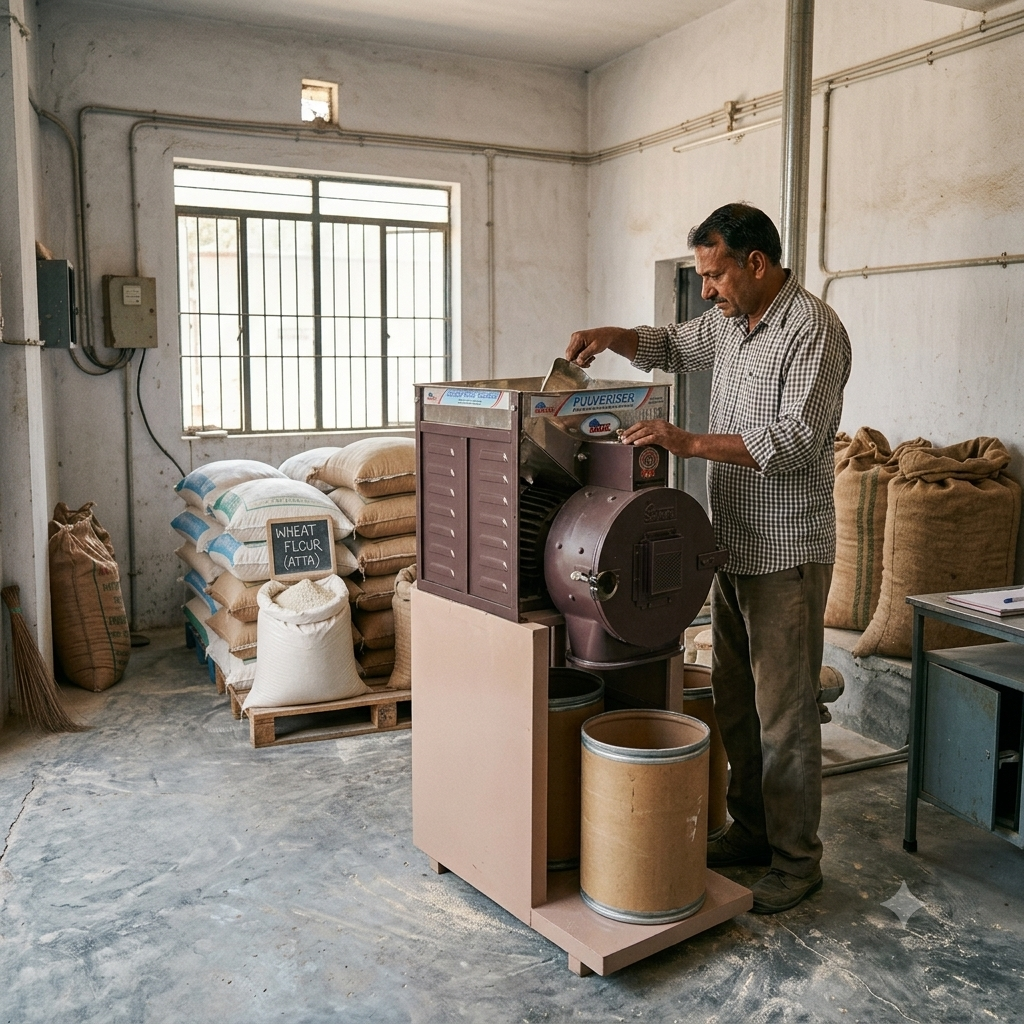
Starting or expanding a food-processing business requires more than choosing a machine with attractive specifications. The right machinery should match your product, production requirements, available space, power supply, workforce, and long-term business plans.
For entrepreneurs planning a flour mill business in India, machinery selection is particularly important because customer requirements can vary considerably between households, small businesses, retail outlets, hotels, and commercial food-processing units. A machine that works well for one business may not be the right choice for another.
Whether you are considering a home flour mill business, a small processing unit, or a commercial flour mill business, making an informed machinery decision can help you build a dependable operation and maintain consistent product quality.
Start With Your Business Requirement
Before comparing machines, clearly define what you intend to process and who your customers will be.
A flour-processing business may handle wheat, millets, maize, rice, pulses, spices, or other grains depending on the equipment selected. Your machinery should therefore be based on the actual products you plan to process rather than simply choosing the largest available model.
Consider questions such as:
- What type of grains or food ingredients will you process?
- Will you serve household customers or commercial buyers?
- What quantity do you expect to process regularly?
- Will the machine operate for a few hours or continuously?
- Do you plan to expand your product range later?
- How much working space is available?
Having clear answers makes it easier to shortlist suitable flour mill machines, pulverizers, grain processing equipment, and supporting machinery.
Choose Machinery According to Production Scale
Production requirements are different for a home-based operation and a commercial processing unit.
A home flour mill business may require compact equipment that is easy to operate, maintain, and accommodate within a limited workspace. A small local processing centre may need a machine with greater capacity and stronger continuous-use capabilities.
A commercial flour mill business, on the other hand, may require equipment designed for higher workloads, depending on the expected processing volume and customer demand.
The important point is not to purchase machinery simply because it has a higher capacity. Oversized equipment can occupy unnecessary space and may not suit the operational requirements of a small business.
Instead, select machinery based on your realistic present requirements while keeping reasonable scope for future expansion.
Consider the Type of Food Processing
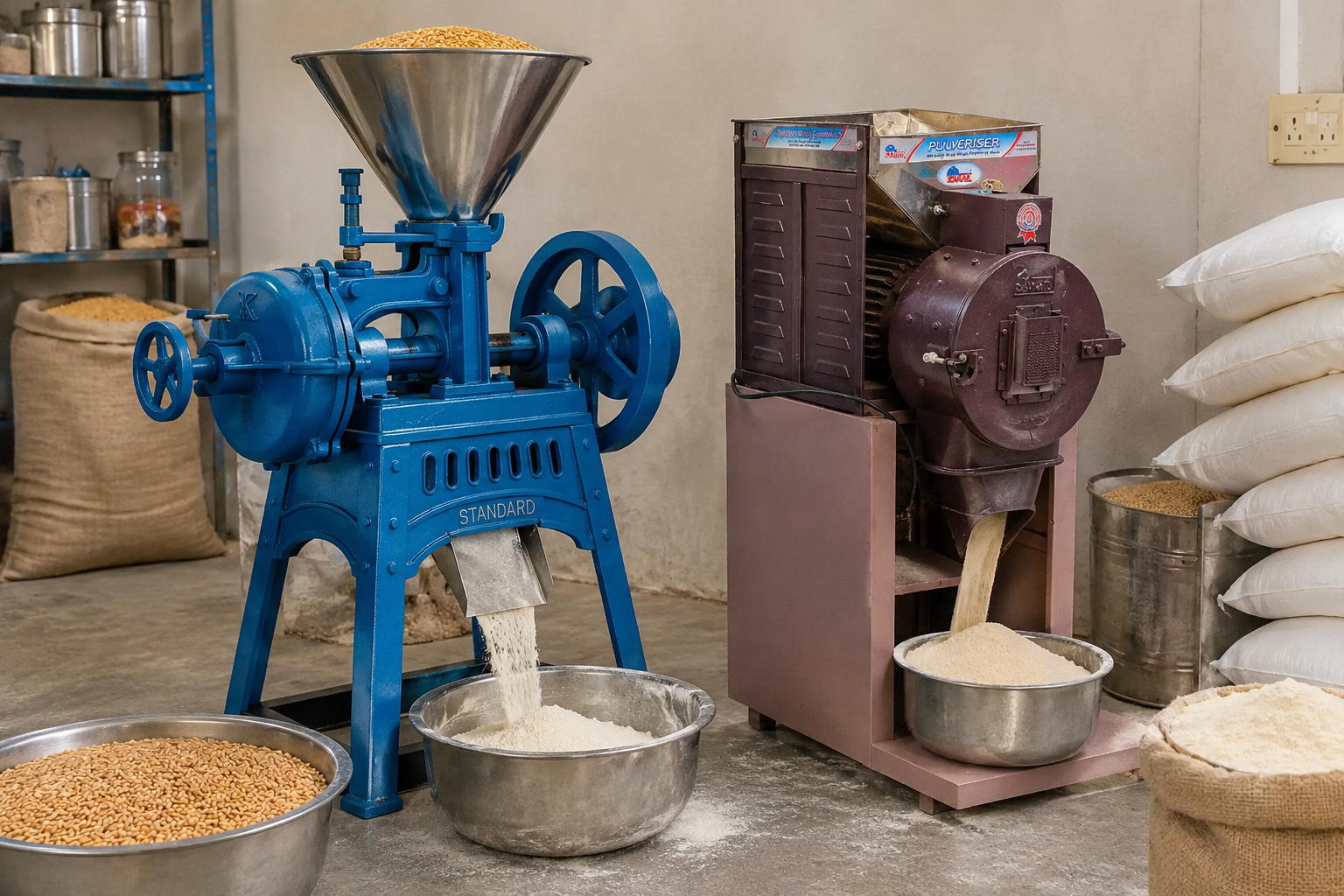
Not every food-processing machine performs the same function. Grinding, pulverizing, milling, cleaning, separating, and processing require different types of equipment.
For example, a flour mill machine is generally selected for producing flour from grains, while a pulverizer may be more suitable for applications involving spices, grains, and other food ingredients.
If your business plans to offer multiple processing services, you may need a combination of machines rather than relying on one machine for every application.
Understanding the difference between grain grinding machines, flour mills, pulverizers, and other food-processing equipment can prevent unsuitable purchases and help you create a more practical processing setup.
Check Power Requirements Before Purchasing
Power availability is another important factor that small businesses sometimes overlook.
Before selecting machinery, check:
- Required electrical connection
- Motor power
- Operating voltage
- Power consumption
- Availability of three-phase or single-phase power
- Suitability of the electrical infrastructure at your premises
A machine should be compatible with the power supply available at your location. This is especially important when setting up a processing unit in an existing commercial space where electrical capacity may be limited.
Discussing power requirements with an experienced machinery supplier before installation can help you plan the workspace more effectively.
Space and Workflow Matter
Machinery should fit comfortably into the available workspace without making daily operations difficult.
Measure the installation area before finalising your equipment. Remember to consider not only the machine’s physical dimensions but also space for raw-material handling, finished products, cleaning, maintenance, and operator movement.
A well-planned layout can make the workflow smoother. Raw materials should be easy to receive and store, while processed material should have a clear path toward packing, storage, or dispatch.
For small food-processing businesses, efficient use of space can be just as important as machine capacity.
Look Beyond the Machine Specifications
Technical specifications are useful, but they should not be the only basis for your decision.
Ask the supplier about the machine’s intended applications, operating conditions, maintenance requirements, and recommended usage. If possible, understand how the equipment performs with the specific grains or ingredients you plan to process.
A professional supplier should be able to explain the practical differences between available models instead of simply recommending the most expensive option.
Look for clear information about:
- Machine construction
- Motor and drive system
- Suitable raw materials
- Recommended operating conditions
- Maintenance requirements
- Availability of spare parts
- Service support
- Installation guidance
This information can help you make a more confident machinery decision.
Prioritise Consistent Processing Quality
For a food-processing business, consistency is essential.
Customers expect the flour, powder, or processed ingredient to have a reasonably consistent texture and quality. Machinery selection should therefore take into account the type of output your customers expect.
Factors such as grinding mechanism, screen selection, operating speed, and the nature of the raw material can influence the final result.
For businesses serving local customers in cities such as Chennai, Madurai, and Tiruchi, understanding local customer preferences can also help determine the type of machinery and processing setup required.
Service and Spare Parts Are Important
Buying machinery is only the beginning. Long-term service support can have a major influence on the reliability of your operation.
Before purchasing, ask where service support is available and how spare parts can be obtained. Understand the recommended maintenance schedule and whether technical assistance is available when required.
A reliable supplier should provide practical guidance on installation, operation, maintenance, and troubleshooting.
This becomes particularly valuable for entrepreneurs entering the food-processing sector for the first time.
Think About Cleaning and Maintenance
Food-processing machinery must be maintained properly to support hygienic and consistent operations.
Consider how easily the machine can be cleaned after processing. Components that come into contact with food materials should be accessible for routine cleaning and inspection.
Regular maintenance can also help identify wear and other operational issues before they become major problems.
When comparing machines, ask about cleaning procedures, maintenance intervals, replacement components, and recommended servicing practices.
Don’t Choose Machinery Based Only on Price
Price is naturally an important consideration for a small business, but it should not be the only deciding factor.
A machine should be evaluated according to its suitability, construction, expected usage, service support, maintenance requirements, and long-term practicality.
The cheapest machine may not always be the most suitable choice, while the largest machine may not necessarily be the best investment for a small operation.
Instead, focus on value, reliability, suitability, and support.
Plan for Future Business Expansion
Your machinery decision should consider where you want the business to go.
A small food-processing unit may initially focus on wheat flour but later introduce millet flour, rice flour, or other processed products. Similarly, a local processing centre may eventually serve restaurants, retailers, catering businesses, or other commercial customers.
Choosing equipment with suitable flexibility can make future expansion easier.
However, avoid purchasing machinery far beyond your current requirements. A practical approach is to select equipment that meets today’s needs while allowing your business to expand in stages.
Work With an Experienced Machinery Supplier
Choosing the right food-processing machines becomes easier when you work with a supplier who understands food-processing applications.
Instead of asking only, “Which machine should I buy?”, explain your complete requirements. Tell the supplier what you want to process, your expected workload, available space, power supply, and intended customer base.
For businesses operating in major Tamil Nadu markets such as Chennai, Madurai, and Tiruchi, local operating conditions and customer requirements can also be discussed during the selection process.
A knowledgeable supplier can then help you compare suitable models and understand the practical differences between them.
Final Thoughts
Starting a flour mill business in India can require careful planning, particularly when selecting machinery for the first time. The right equipment should match your production requirements, available infrastructure, product range, workspace, and plans.
Whether you are establishing a home flour mill business, expanding into a commercial flour mill business, or setting up a broader food-processing unit, avoid making your decision based solely on machine price or capacity.
Instead, evaluate the complete picture: application, output quality, power requirements, maintenance, service support, spare-parts availability, and long-term suitability.
A well-planned machinery choice can provide a strong foundation for reliable day-to-day operations and help your food-processing business grow practically and sustainably.